Tuesday, September 29

The Biodynamic Acre

I have started a 'trial' of biodynamic treatments on one acre. I am using Aracaria's Preparation 500 which is "made from cow manure that has been buried in cow horns during the cooler months of the year. It enlivens the soil by improving soil structure and microbiological activity, promotes humus formation and water holding capacity. Our manure comes from our own lactating cows and the horns have been buried on our farm."

P500 contains 15g of 500 blended with 10g of biodynamic Cow Pat Pit compost. The CPP contains the biodynamic preparations 502 - 507 (yarrow, chamomile, oak bark, nettle, dandelion and valerian) and is also made on our farm using our own biodynamic cow manure. CPP further enhances fungi and bacteria growth."


I put the P500 into a stainless steel bucket of rain water and stirred for one hour making a vortex or crater in one direction and then reversing the direction and making a vortex in the other direction.
The stirred preparation was then sprinkled with a whisk brush over the ploughed acre.
 
All a bit mystical but I'll be interested to see the results in the vegetables and fruits produced. It certainly can't hurt...though I did administer on a full moon which may be not the best time.

Monday, August 24

Back burning

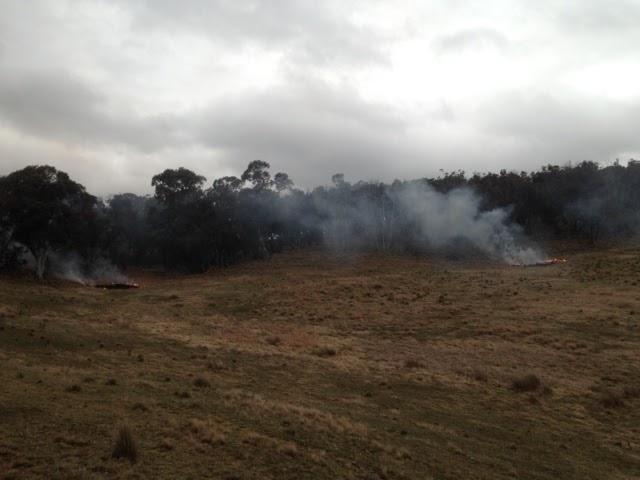
It was perfect this weekend for back burning - dry grass, cool temperatures and the chance of rain. Still sat and watched the grass burn until the rain came and put out the fires. We desperately need to burn off the dry grass and wood in the trees behind the house but will have to wait for a north westerly breeze to blow the smoke away from the house.


Winter Wonderland

 For the first time we had snow that stayed on the ground in July- 15cm for three days. Good snowman making snow too. However, not what we needed in the middle of the lambing season and we lost about 6 lambs.


Thursday, September 25

Sunday, September 21

Storm Clouds


 Before the storm looking east. The light was almost yellow and birds were flying west to get into the woods for shelter. You have to be strong of mind to live somewhere with this much sky!


Saturday, September 20

It treally does snow at Daramalan


This was in mid August - a really cold, grey day when all we could do was stoke the fire and watch old movies. An hour of snow and everything was white, an hour after that it had all gone.

Monday, September 15

Grinding the Blades


We have just finished shearing the Border Leicester flock rams and the First Cross ewes. Big thanks to Craig, Rick and Justin for their great work and patience in the wet weather. Every sheep on the property has now been sheared, drenched and back lined, the latter because of a neighbour's roguing lice-ridden sheep!!

Now it's time to fix up the fences and tidy up around the place. My to do list never seems to get any shorter and maintaining the fences is a bit like painting the Harbour Bridge but it has to be done. Better in the warmer days we are having now than the cold and wet July and August.

Moonlit Yards


The sheep yards are best viewed by moonlight - that way I can't see all the work that needs to be done to repair the damage. Some days it feels like every gate is off its hinges and every panel has a gap big enough for a sheep to push through. Even the race needs resurfacing and re-fencing. It will all have to be done this month prior to lamb marking....and the moon is new on September 24th so now is the time!!

Fire in the Sprinter Sky


Now that winter is almost over thought I should post a classic Daramalan winter sky. Few more cloudscapes to follow in the next few weeks. We have had a wet winter's end - so much so that I agree with recent calls to drop the four seasons and adopt a five season model incorporating "Sprinter" and "Sprummer" and dropping Autumn altogether.

After all splitting the year into four seasons is arbitrary and the Indigenous Australians had anywhere from two to six to mark changes in the climate. Why should continue to adopt a European convention that dates back to pagan times?

While we are at it maybe we could have a joint Republic and Seasons referendum - that would put the PUP amongst the pigeons.


View envy


I thought that the Daramalan views were good but this is spectacular!! South of Cowra and looking north to Wyangala dam from a 30 acre slice of paradise. Plenty of work to be done and fun to be had!

Monday, November 5

Daramalan/Logancrest Ram Sale November 12th


So, here are the Daramalan Border Leicester rams for sale on Monday November 12th at Logancrest, 5 minutes from Crookwell and 25 minutes from Goulburn on the Crookwell-Goulburn Road. Viewing from 12:00 and auction at 1:00 pm with Steve Ridley from Elders holding the gavel as always.

The rams are as good as they come and the best we have produced so far. We hope you can make it to our third sale and that you are impressed enough by the condition and breeding of the rams to bid for them. We are sure they will work well for you in your enterprise. Thanks to all of our old and and new clients - we very much appreciate your support and feedback. Thanks also to Sharon and Craig Coggan of Logancrest Poll Dorset Stud for hosting the sale.

See you next Monday!!

Wednesday, October 10

Renault Print Ads


I have never driven a Renault Twingo but I like their whimsical advertisements particularly as they feature sheep!! I really like the print ad shown below and keep asking my shearers to have a go!!


For what it is worth Top Gear said "Far better styled, and available in right-hand drive, the new Renault Twingo is a really decent stab at the city car market. The only catch is the price, which may not seem far enough off the bigger, better Clio." Seems to be about 6/10. I'll stick with my Subaru Outback and the old ute.


Thursday, October 4

The Ram Class of 2011 - Ready for sale November 12th


Here are the flock rams in the yards before shearing in August - they are really filled out now and will be ready for the sale on November 12th at Logancrest, Goulburn Road, Crookwell.
There is also a short video of the rams from late September on the website (http://www.daramalan.com.au/ram_sale.html) - not great quality but good enough to see their structure and condition.


Etna, Vico and Rivelin arrive at DBLS!!!


Etna (#4) and Vico (#7) with Ashley Corkhill of Normanhurst Border Leicester Stud, Boorowa

On 27th September we bought three new rams from the Corkhill family's Normanhurst Stud in Boorowa. The two stud (Etna and Vico) and one flock (Rivelin) rams were sired by Cadell Stud rams and Normanhurst ewes and all had good bloodlines with Cadell and Retallack influence. Rivelin and Vico are also registered $uperBorder$ meaning that any First Cross Ewes they sire can be marketed as such and hopefully for a small premium. All up three very good purchases, genetically and financially. They will all be working very hard next year at joining time.

Not the best day though as my car broke down halfway between Crookwell and Boorowa. If it had not been for the kindness and genorosity of John Rankine (http://www.jrdistributors.com.au/) and Brad Croker of Elders Crookwell the whole day would have been a right off. Now I have to just be patient about the car getting repaired.......

Thursday, September 13

Ear tag colour codes - Purple for 2012


"The ability to trace livestock from property of birth to slaughter is crucial to the safety of red meat.
The Australian red meat industry has implemented a national system to ensure the quality and safety of beef, lamb, sheepmeat and goatmeat.

The National Livestock Identification System (NLIS) is Australia's system for identification and traceability of livestock. It was introduced in 1999 to meet European Union requirements for cattle exports. Since then it has expanded to enable cattle, sheep and goats to be traced from property of birth to slaughter for:
  • Biosecurity
  • Meat safety
  • Product integrity
  • Market access
NLIS is endorsed by major producer, feedlot, agent, saleyard and processor bodies. In addition to this it is underpinned by State/Territory legislation, which forms the regulatory framework for the system.
NLIS Ltd operates the central NLIS Database on which the livestock movements must be recorded. "

From www.mla.com.au

Naturally I am as interested in the colour sequence as I am in biosecurity. Is there any significance to the colour order? Not that I can tell or find out from anywhere. It is a clever system though and makes identification easier when drafting out the oldest sheep. Also I was taught that ewes are tagged in the right ear and rams in the left....because 'women are always right'. Boom tish!!


The 2012 Lambs are here!


We started lambing about three weeks ago and the Border Leicesters are about three quarters done. Plenty of twins and some triplets will make for a busy lamb marking day next week. We expect to have over 125 lambs to mark so it has been a good season. Purple tags this year, green last and orange the year before - I'll post the sequence at a later date.

The Merinos started early last week and so by end September we can mark the first cross lambs. Don't have a photo (yet) but there is one lamb with a black saddle - very unusual and very cute!


Sunday, September 9

Shepherds from the Landes region of France


The region of the Landes is an immense plain situated in south-west France delimited by the Atlantic Ocean to the west, by the banks of the Adour to the South and by the ones of the Garonne to the north-east. Today it shelters the largest forest in Europe, constituted essentially of pine trees planted in the middle of the 19th century on Napoleon III’s initiative or decree.


The department of Les Landes, the second largest department in France, with an area of about a million hectares, was created in 1790 by uniting administratively a mosaic of fourteen small local pays.

The low population in Les Landes, about 300,000 people, has not changed much for the last 150 years and before becoming the greatest area of forest in France during the nineteenth century, this infertile land of moving sandy ground, becoming marshland in winter when the rivers swelled and flooded,  truly merited the name of moor - la lande in French. It was known as the French Sahara. It attracted neither immigration, nor commercial traffic. There were various experiments to control the sogginess of this desolate region, together with agricultural experiments - rice, mulberry trees, tobacco, peanuts - which all failed.


My interest (as always) though is with the shepherds who had a unique way of moving around the region with their flocks. There were few ways to earn a living in this unhealthy, temperate desert, keeping flocks of sheep being a major occupation. In 1850, there were 1 million sheep; by 1862, there were 527,000, and by 1890 this had reduced to 295,000 as forest replaced the frugal moor pastures. The land was so poor that it would only support one animal per hectare. Thus, the shepherds and their flocks roamed widely over the area, moving up to 20 kms a day over communal moorlands to find sufficient grazing for the flock. At night, the sheep were penned in a sheepfold, which ensured that the animals’ manure was not dispersed unnecessarily. The manure was the main crop from the sheep, being used on the fields. The output of twenty to thirty sheep was required to adequately fertilise one hectare of the the poor, acid Landais soil.
  • 1 kilogram of rye bread fed an adult, a family of eight to ten people would eat 4,000 kg rye bread a year.
  • 3,200 kg flour are needed to make 4,000 kg bread.
  • 4,000 kg rye grains are ground to make 3,200 kg flour.
  • 4 hectares of land are needed to produce 4,000 kg rye grains.
  • 60 tons of manure are needed to fertilise 4 hectares of land.
  • 100 sheep will produce 60 tons of fertiliser.
  • 100 hectares of moorland provide food for 100 sheep.
Stilts first appeared well before the forest, when Les Landes was an immense marshy country with the vegetation primarily consisting of grass and undergrowth. Principally, it was shepherds who lived in this landscape. The shepherds had several reasons for using stilts in order to more easily make a path through the vegetation when the shepherds travelled the long daily distances required by their sheep-tending to avoid wetting their feet in the marshes but their main use was to be able to supervise their flocks of sheep from afar.
The first records of stilts in Les Landes date from the beginning of the 18th century. However, it is not known whether using stilts was invented locally by the shepherds, or whether they were an import, say from the Flemish region of Belgium, where stilts had been used since the Middle Ages.
Landais stilts were made from two pieces of wood:
  • the escasse (“leg” in landais patois) from where comes the modern French name for stilts: l’échasse; and
  • the pé paouse (“foot rest” in landais patois), which is fixed on the escasse, generally giving a stilt height ranging between 90 cm and 1 m 20.
The stilt user attaches the stilt to his (or her) leg with two leather thin straps.

The use of stilts by the shepherds for work purposes disappeared gradually between the middle of the 19th and the beginning of the 20th century with the establishment of the forest, which drained the marshes and eliminated the pastures, and thus the sheep and their shepherds on stilts.Today none of the original marshy Landes remains.


Monday, September 3

Salvador Dali Ted


The farm dogs are working dogs and an enormous help....except in the shearing shed when they are a nuisance unless chained up. Blue is pretty good overall, Jess sleeps in the fleeces (she is almost 12 years old) and Ted.....well Ted just likes impersonating Salvador Dali whenever he can!!

Sunday, September 2

Lick Feeder and ELMS Blocks


In an effort to get the flock rams in top condition for sale later this year (November 12th) we are supplementary feeding this year. We have posted news about the Bromar lick feeder previously but we are also using Elders Livestock Management Solution (ELMS)  lick feed blocks. The blocks provide a mineral supplement for the sheep.

"As green feed can contain a poor balance of nutrients critical to maintaining optimum health and productivity it can significantly reduce an animal’s ability to efficiently convert the available feed into meat, milk or wool. It may also contribute to metabolic conditions such as grass Tetany and substantially reduce an animals natural ability to resist infections including parasites."

The ELMS block contains  "an appropriate combination and level of the nutrients required by sheep and cattle to perform at their peak whilst grazing green pastures and fodder crops
including high levels crushed grains, carbohydrates, and bypass protein and a specially prepared blend of both normal and high availability forms of vitamins and mineral."
They are designed to stimulate the rumen to allow animals to deliver higher levels of feed efficiency. 

Let's hope the extra cost and work is repaid in November!

Thursday, August 2

Weed alert

It's that time of year again to try and eradicate serrated tussock (Nassella trichtoma) from the property. It's an almost impossible task as not everyone in the area is as vigilant despite it being listed under the Noxious Weeds Act 1993. So it continues to be a major environmental concern in the Southern Tablelands.

Now is when they are easiest to identify and kill before they can set seed in November. We use a combination of herbicidal spot spraying and, an old favourite, the mattock. We always carry a mattock on the quad bike when we inspect the sheep and a couple of big hits is all it takes to physically remove the plant.

Mostly we are winning but we also have all four thistle species, some blackberry (under control) and plaenty of horehound. The latter used to used in brewing a non alcoholic and bitter 'root' beer. Don't care fort the taste myself but some of the beer labels were fabulous.