Tuesday, October 19

Annual Ram Sale

Sale day is fast approaching - Monday November 1st at 1pm on property at Logancrest, Crookwell Road, Crookwell - the Coggans residence. It will be a great day and a huge success!
We are offering 40 Daramalan Border Leicester Flock Rams (pictured below), 190 First Cross Ewes, 120 FX Ewes with lambs on foot, 40 Logancrest Poll Dorset Flock Rams and 100 two year old Merinos. A sort of vertical prime lamb market offering with Merinos, Border Leicesters, First Cross Ewes and Poll Dorsets.


Selling Agents for Daramalan are Elders and for Logancrest are Landmark so should get good local coverage. There will be advertisements in the Town and Country and Crookwell Gazette. Also Daramalan will be showing a few rams at the Elders Goulburn "Innovation in Agriculture" store day on October 28th. Come along and meet the rams and me!!

Sunday, August 29

The Humility Block

If only I could machine sew a quilt as beautiful and as complex as the Amish communities of North East America. The designs are inspirational and some may make it onto my glass cutting table as plates, bowls or panels. Some may become small quilted panels, cushion covers or even bedspreads for the farmhouse. Having made two quilts to date and lots of cushion covers I have a long way to go before I can say that I have made a 'perfect' quilt. There is a myth about the Amish putting in a humility block - a block with one mistaken stitch to acknowledge that only God is perfect. Not true at all but a nice story. My quilts are absolutely full of humility!!
There is another myth that black American slaves used quilts as signals when they tried to escape on the 'Underground Railway'. Another great story but not true. Quilts have been made to celebrate, if that is the right word, their lives and escapes but not at the time as signs for safe houses. 
In the spirit of the humility block though I would like to nominate the southern half of Lot 5 as the most unpretentious and mistake ridden block on the property.....Not sure we will ever get it to be as productive as the rest but it does fit in the whole!
Ciao.


Wednesday, August 4

Lambing season started

Yes, she did come back to reclaim her third lamb so all's well. The Border Leicester ewes are lambing every day now and we have about 70 lambs on the ground and so another 150 to come. Mainly singles so far but a few twins and triplets too. Our Merino ewe has had triplets too and all are doing well. Luckily no quads yet this year. A few deaths unfortunately - three lambs and two ewes, one from pregnancy toxaemia and the other from unknown causes. The first cross ewes are still doing well and lambs should be dropping later in the month. So far so good and Zing and Zeno seem to be working well as guard animals and keeping the local foxes at bay.


Next jobs are shearing the rams, re-fencing the eastern boundary, sowing alfalfa in the 40 acre river paddock, wood chopping and lamb marking. Challenging and busy time of year but thankfully it is getting slightly warmer and the days are lengthening. We have had some bitterly cold days this winter and about twice the rainfall as last year. Even with better pasture, including the clover and rye grass sown on the eastern 100 acres, we have started to feed the sheep some hay and Triticale grain to keep their weight and condition up for the next few months as we plan for our sale on November 1st 2010. Mark it in your diary! There will be 40-50 Border Leicester flock rams, 30-40 Poll Dorset flock rams and the 275 First Cross Ewes, a vertically integrated sale day!


See you there.

Tuesday, July 27

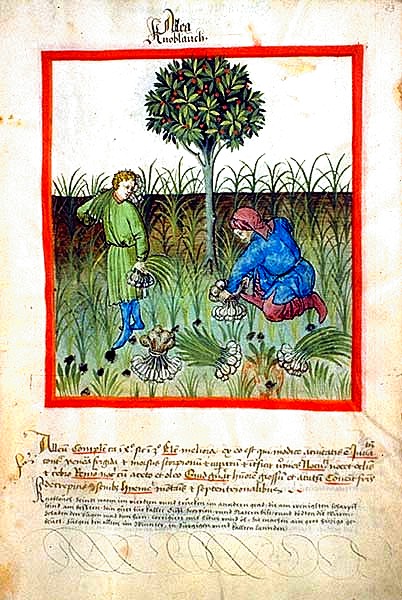
Organic Garlic - first experimental crop

In late April we planted 100 cloves of garlic from three or four different varieties. The garlic plot while small is an experiment to see whether it is possible for us to grow organic garlic successfully. The planting is a direct response to the irradiated Chinese (a staggering 77% of global production) and Argentinian product that is being sold in the major supermarket chains. That just cannot be good for you and since garlic is one crop that can be stored for 9 months and preserved so it can be used all year it has to be a worthwhile effort. Plus we cook with it almost every day.
Allium sativum is a member of the onion family and relatively easy to grow in a temperate climate preferring acid soils - okay so far at Daramalan!! Wild and cultivated garlic has been eaten and used medicinally for thousands of years, by Egyptians, Syrians and Romans. It even gets a mention in the Bible and the Talmud (not sure about the Koran). It was used to treat parasites, digestion, low energy, colds, breathing disorders and was thought of as a cure-all.
Garlic is mentioned in the Bible and the Talmud. Hippocrates, Galen, Pliny the Elder, and Dioscorides all mention the use of garlic for many conditions, including parasites, respiratory problems, poor digestion, and low energy. The Romans saw it as a cure-all.
Some studies have found  garlic to have antibacterial, antiviral, and antifungal activity. It is also claimed to help prevent heart disease and cancers. When crushed garlic yields allicin, a powerful antibiotic and antifungal compound. It also contains sulphur containing compounds and various enzymes, proteins, minerals and vitamins. The sulphur containing phytochemicals responsible for the sharp flavor of garlic are produced when the plant's cells are damaged. The strong odour causes "garlic breath" (garlic is also called the 'stinking rose') and the allyl methyl sulphide "smell" is excreted through the skin. Ever sat on the Paris Metro?!!
Garlic myths and legends abound - after Satan left the Garden of Eden the smell of garlic came from his left footprint and onion from his right. Garlic cloves warded off vampires, werewolves and devils. Hindus and Jains avoid using garlic as it heats and stimulates desire and Islam views eating garlic and going straight to the mosque as inappropriate.
Whatever the myths and health benefits we will hopefully harvest 100 bulbs in early summer and have enough for our needs. All going well then there will be 1000 cloves planted in 2011 and we will supply family and friends and maybe even try a farmer's market.
Ciao.


Monday, July 26

Zeno and Zing, sheep guardians

We have added two more stock animals to the Daramalan property, Zeno and Zing the alpacas. Both are wethers and born in April and March 2004 respectively so they don't qualify as adolescents (Tuis) but are adult males (Machos) and their life expectancy is 15 - 20 years. Zeno is medium fawn and Zing is light brown. Really they are very similar in colour so not sure what the alpaca colour charts (whites, silvers, browns, greys and blacks) mean. They are already about one metre at the shoulder and weigh 50 plus kilos. Hope they are as easy to handle at shearing time!
They seem to be settling in well and because they have pads not hooves they will do very little damage to the pastures and should thrive on the grass, clover and forage crop mix. Alpacas are one of 4 South American 'camel' species and they are hardy, intelligent and gregarious animals with strong herd instincts. They have an innate dislike of dogs and foxes and hence their inclusion at Daramalan.
Males and females are very protective of young animals, will bond with the grazing sheep flocks and have great eyesight over kilometres of distance. If threatened they will sound a piercing alarm cry and if required attack a predator with their front hooves. They are an essential and environmentally friendly part of our flock management practices at lambing time. We are confident that Zing and Zeno will improve our lambing percentage to make the 2010 drop a fantastic season. Just to be safe this year though we have reluctantly laid 33 fox baits on the southern and eastern boundaries.


Adios!

Sunday, July 25

Mine's a pint


I have not been a regular pub drinker since my early twenties but have recently started going to my local with a friend for a beer or two. All a bit "Sliding Doors" really as I mostly listen and laugh incredulously at how other peoples' lives and problems develop into full blown crises. Going to the pub used to be easy. "I'll have a schooner of Reschs" doesn't work any more as my local serves over twenty different beers ranging from full strength to gassy low alcoholic and chemical tasting brews (like making love in a boat - f@#$ing close to water as we used to say). Also I am mystified by the beer glass sizes, though in reality they have not probably changed much in time. Half a pint in New South Wales is a middy, in Queensland a pot, in the Northern Territory a handle and in SA a schooner. Even a pint is different in South Australia where you only get 425 mls rather than the 570 mls in all other states. Crow eaters also only get 285 mls in their 425 mls schooner.  At least a jug is 1.14 litres wherever you drink and since that's what we drank then I never needed to know the other sizes!


I have recently started to contemplate brewing my own beer again after a thirty year gap. The last experiment in my wardrobe at university exploded and ruined my only suit so this time it will be on the verandah. Might be a little bit too cold for the yeast to work properly this time of year so the first batch is taking a while. Might look into growing some hop plants and buying small quantities of malting barley to see if I can produce a drinkable drop. Then again it might just be simpler and more entertaining to order a glass from my local.


Cheers.

Wednesday, June 30

The Gandangara - owners of the land


The traditional owners of our land were the Gandangara people who lived in south eastern NSW from Lake George to the Nepean River and from north of Goulburn to Camden. Their tribal names includes meanings for east and west. In 1802 the explorer Francis Barallier met them near the Wollondilly River and in 1816 troops were dispatched to capture and kill Aborigines after 14 settlers were killed. By 1848 there were only 25 Aborigines registered in Gouburn after the influenza epidemics of 1846 and 1847. According to local historians it is doubtful whether there were ever large numbers of Aborigines in the Goulburn area.

They believed in animal people (burringilling) who lived in the dreaming in clouds, scrub, mountains, trees and water courses. The most important spirit was D(h)aramalan and his voice is represented by the bullroarer cut from a tree. In initiation ceremonies a rock crystal stone is used and the myth says that when once Daramalan caught a boy and hit him over the head a tooth fell out and became a rock crystal.

We chose Daramalan as our farm name because it represented a powerful and auspicious spirit that had a local connection to Goulburn. Daramalan (or Daramulum) means one legged and was the son of spirit Baime and his emu wife Birrahgnooloo. There is a rock carving in Sydney's north west showing him in half profile with one arm, an emu back and a club foot.

We would like to acknowledge the traditional owners of our land.

Footnote: Daramalan Border Leicester Stud has no association or relationship, commercial or otherwise, with Daramalan College in Canberra.
The above image is by Daniel Goodwin.